
The world knows him for his pure, unadulterated joy at the sight of a Class 37 locomotive, but Francis Bourgeois has always had his eyes on a different kind of engine, the kind that leaves the atmosphere entirely.
In his new documentary, Mission to Space, Francis trades the railway platforms for centrifuges and hyperbaric chambers. In a new interview Francis talks the transition from tracks to stars, the vulnerability of the journey, and why the “Big Boy” steam engine still holds a piece of his soul.
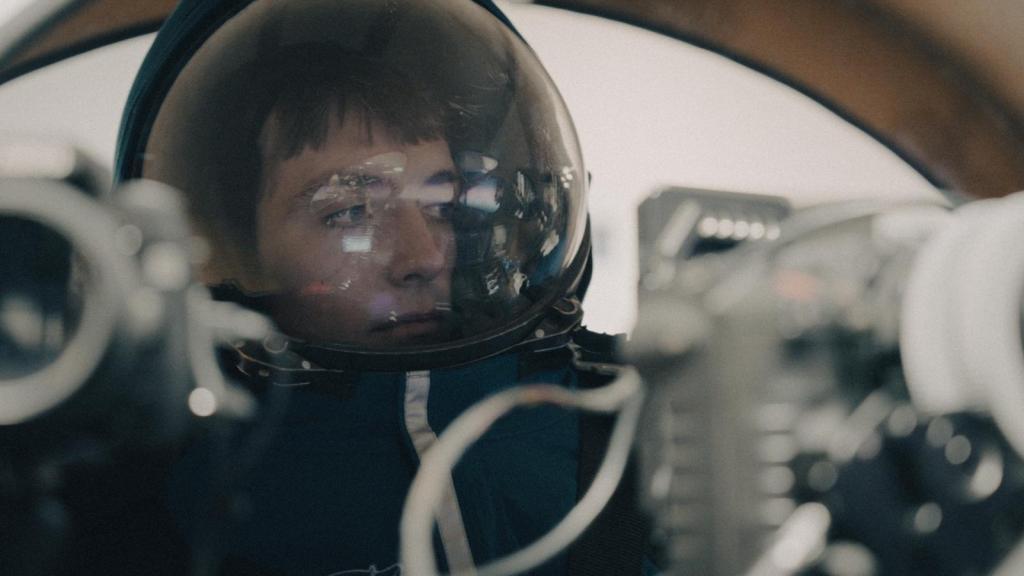
What was the driving force behind Mission to Space?
It’s an arm of my broader engineering interest that I haven’t really expressed before, because my main social media output is about trains. It was a great opportunity to not only get involved in something really exciting from a space and engineering perspective, but also to show the world that side of me as well. It reignited some of that childhood excitement.
What fascinated you about space as a child?
I used to visit the Science Museum with my parents, where they have an Apollo Command Module and a deconstructed booster hanging from the ceiling. My brother used to call it “The Uh-Oh rocket”, because of its deconstructed state. It really caught my attention because, from a young age, I had a very mechanical mind. I had a Saturn Five toy and the idea of space completely exceeded what I knew and what I could see outside my window.
I loved aircraft, but to think that something could actually breach the clouds and the outer atmosphere was, for a young mind, extremely exciting. Then later on in my degree, it was one of the things I considered as a potential avenue, especially with the European Space Agency hotting up – not really as an astronaut, more as an engineer.
So it was as much about the process of getting into space as what happens when you’re there?
Yes, exactly. In Mission to Space, the physical experience of being in a centrifuge, feeling the thrust, hearing the noise, was amazing. Having said that, the opportunity to experience the overview effect and see the world from afar feels like it would give you a new perspective on life outside your own little bubble – if everyone on Earth could experience it, we would be living in peace forever.
The idea of a social media star becoming an astronaut seems unlikely. Did you think it was a genuine possibility?
When we started out, there was an element of chucking myself in the deep end and seeing what happened. But with private space companies leading the way with research-based space activity and commercial tourism, accessibility to space is changing. What gave me extra confidence at the beginning was that my social-media profile could serve as a great conduit for advertising the new age of space, not only in getting people into a career in astronautical engineering, for example, but making people realise that perhaps they could become astronauts. As long as you’re keen, you’re ready and you can absorb information, you could be considered for a training programme.
Your first step on the journey comes when Tim Peake reaches out to you. What was his most valuable advice?
There were so many questions I wanted to ask him: for our first interview, I just wanted to find out what it was like being in space. His main advice was about that step where you know you are potentially leaving your family behind forever. You and your family need to understand the repercussions of that, which I found was a big hiccup. Tim is not only someone who can promote space, but he’s a lovely person, a kind soul, and he just wanted the best for me. He felt a bit like a guardian angel.
Your girlfriend Amy says at the outset that she’s most concerned about the physical aspect of it. Was that your primary concern as well?
Yes, I asked Tim at the beginning about being a tall astronaut because I was worried about my postural hypertension: sometimes, when I stand up quickly, I feel dizzy or even pass out. So my ability to withstand G-force in the Z-axis was definitely a concern.
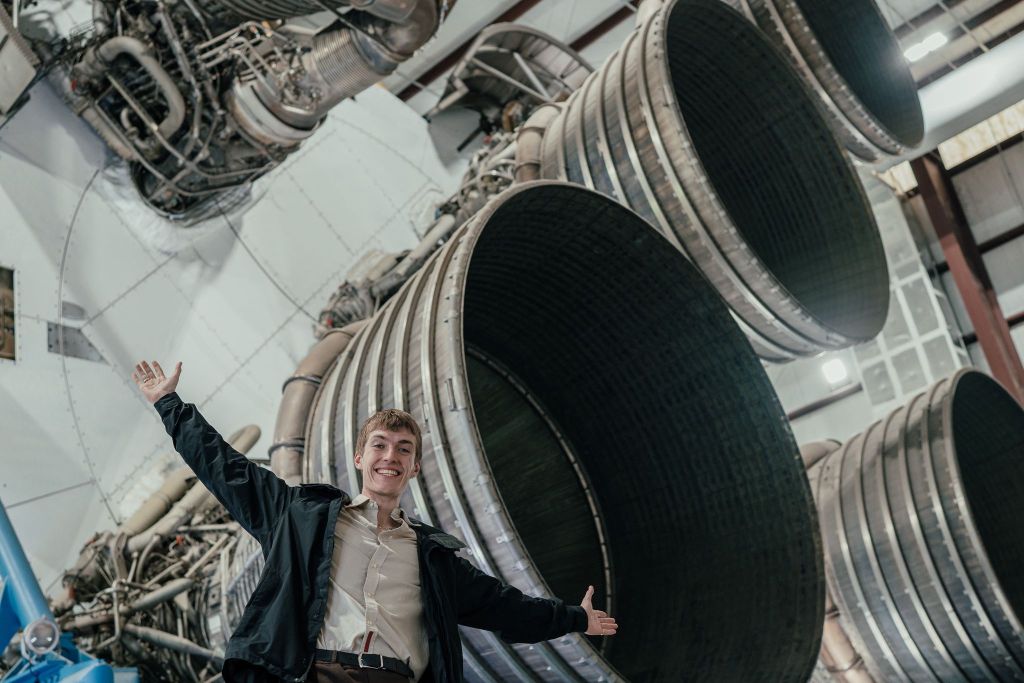
The reality of space travel involves a psychological toll as well. Did you anticipate that?
There was a lot that I didn’t really anticipate. I wasn’t really ready for experiencing all these things without Amy, and that caught me off guard on a few occasions. Separate to potentially leaving Amy behind, for example, being in the hyperbaric chamber brought back old feelings of claustrophobia. I got swept out to sea for a moment when I was younger and had difficulty with confined spaces afterwards. Although I got over it, I felt the sensitivity of that feeling very heavily in that moment.
We see you being sick and singing karaoke on the one hand, but also you in the hyperbaric chamber or recording a very emotional message for Amy. A lot of it is quite exposing. Were you concerned about any of that being broadcast, or did you want to show your full journey as it really was?
There was a side of me that wanted this to be a very macho demonstration of my bravery, but it ends up being quite the opposite, really.
It’s brave in a different way, perhaps.
Yeah, that’s right actually. Through my social media, I’ve learned that being vulnerable and clear and open with my emotions is something people connect with more. Ultimately, I felt it would be better to show that vulnerability.
What was the most exciting moment of the whole adventure, where you just thought: I can’t believe this is happening?
Experiencing a rocket launch for the first time was incredible. I love to absorb noises! Also meeting Mark Marquette at the American Space Museum, because I love feeding off other people’s passion and enthusiasm. I don’t think I’ve ever met anyone like Mark, an amazing character who got me so amped up and connected so strongly to all of the objects in his museum. It was almost a spiritual experience in a bungalow! Throughout the journey, we were meeting so many amazing people, not just enthusiasts in the space industry, but young engineers in private companies that are leading the way. And seeing Big Boy meant a huge amount to me.
Tell us a bit more about Big Boy.
It’s the largest class of steam engine in the world, created at the end of the Second World War to haul heavy freight over the Rocky Mountains. Essentially, their design is two steam engines, under the umbrella of one engine, sharing one massive boiler. Big Boy is like a two-storey building: standing next to its wheels was so discombobulating because everything was larger. Conversely, it runs on the same track width, so it’s an incredible bit of engineering. Even though it wasn’t moving, I felt its power and presence, and it was overwhelming.
Seeing it was a tangent I really felt we needed to go on. That, in turn, became part of my broader realisation of what really made me tick. The prospect of becoming an astronaut was exciting, but really I wanted to return to that initial spark I felt when I was younger: the pure engineering of it. Through that, I could find the position that made me feel happiest in the space industry.
Has making Mission to Space changed your expectations of yourself, or your feelings about space?
It’s made me want to become fitter, that’s for sure! Meeting people at that physical apex of literally being able to rocket yourself up to the outer atmosphere, I did come away feeling like I needed to get myself into a better physical state. But in general, I’m more sensitive towards my time here on Earth.
It sounds weird, but the experience has helped me to understand not so much my desire to get out into space and the new age, as exciting as it was to witness, but more how special it is to be on Earth and how much we need to cherish what we have. In my case, it was about really valuing my relationships.
Should we be spending so much money on space exploration when our environment on Earth is on the brink?
Even though money is being pumped into getting into outer space when there are arguably important investment priorities on Earth, recent developments in space technology have been incredibly valuable for us here, especially in manufacturing. Because the environment is so sterile, you can 3D-print certain things in outer space, like a heart or a perfect spherical lens. The scientific research side totally makes the investment in space travel justifiable. And it’s not shouted about enough in the news that we are really rocketing towards potentially living on the moon, with Firefly, SpaceX and the Artemis missions, so that’s really exciting.
What sort of conversations are you hoping to start with Mission to Space?
Should we be going out to space or focusing on what we have here on Earth? So many people witnessed the moon landing in 1969, and there is a real possibility of that happening again within the next couple of years: will it be as impactful? I would also love people to cherish their partners and family, the people they connect with and love, because I feel like that is the crux of the story.
What’s next?
More railway journeys! I might be going to Japan for the first time to experience the Shinkansen. And some exciting railway preservation activities: I’m contributing to bringing one of my favourite locomotives, a Class 37, back to the mainline, so that will be back on the rails in three months or so.
Mission to Space with Francis Bourgeois airs Sun 25 Jan and Sun 1 Feb at 18:50 on Channel 4
This is a must-see. Francis, who is already loved on social media for his trainspotting, is such a joy to watch, and his energy and enthusiasm know no bounds, even when training proves far tougher than he expects. Standout two-part documentary series and one of the best I’ve watched in quite a while.